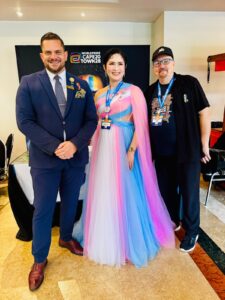
Major street artwork titled Embracing Openness is creation of local artist Ellena Lourens
Belgium has today proudly unveiled in Cape Town a landmark street artwork- an inspiring wall mural to celebrate openness and diversity in the lead up to world-famous Cape Town Pride and as part of Belgium’s call to the world to embrace openness to diversity. Located in the city centre, Embracing Openness is the work of South African artist Elléna Lourens, renowned for her vibrant wall murals and distinct artistic style.
Embracing Openness has been commissioned by the FPS Chancellery of the Prime Minister of Belgium, in collaboration with the Consulate General of Belgium in Cape Town against the backdrop of this year’s International Public Art Festival (IPAF). The work is part of Belgium’s ongoing campaign which invites societies to embrace openness so all can benefit from the virtues of an open, tolerant, and inclusive society which can ensure progress and prosperity for all; values shared by both Belgium and South Africa.
“We are extremely proud to have unveiled this incredibly creative work. The choice of a wall mural was a logical one for us because street-art is highly engaging form of art public spaces and so it’s the ideal platform for this important message,” explained Mathias Bogaert, Consul General of Belgium in Cape Town, “From the moment of conceptualisation, Elléna knew exactly the openness message we wanted to convey. Embracing Openness echoes the spirit of Belgium as home to diverse communities and cultures for whom this value is key to progress.”
Lourens’ unique image embodies themes of love, unity, understanding, and acceptance. The artist’s use of her signature vibrant palette and subtle interplay of shapes are conceived to offer passersby a warm embrace and to provide them an opportunity for a celebration of diversity and for reflection on the struggles for openness.
“For me this commission connected strongly with my approach to art, I wanted to create something impactful yet warm so striking but not intimidating, to communicate what it feels like to embrace openness. The location means it will be visible to all celebrating pride”, commented Elléna Lourens, “Embracing Openness is very much about all the vibrancy of our cultures, by representing the diversity in two ways, in terms of love but also by offering a diversity of perspectives”.
Together, Belgium and South Africa are diversity pioneers. Last year, Belgium celebrated the twentieth anniversary of the legalisation of same-sex marriage, Belgium being the second country in the world to take this step. In the same pioneering spirit, South Africa was the first country on the continent to do the same.
The Embracing Openness mural is located at Alfred street, back of BP station, Greenpoint, Cape Town, 8001.
_________________________________________________________________________________________
About the artist
South African artist Elléna Lourens began working on personal and collaborative creative projects while in school. Since then, she has further pursued illustration, street art, painting and embroidery. Her style lends itself to the past in its representation of ancient symbols, patterns and colour schemes, while voicing an intuitively current aesthetic that resonates and seeks to redefine emotional iconography. She has immersed herself in the creative world. Working alongside established artists as well as furthering her own practice.
_________________________________________________________________________________________
About Belgium
Located in the heart of Europe, Belgium is a highly developed nation of over 11.5 million people with a reputation for innovation, hard work, partnership, and multilingualism. Strategically located between Germany, the Netherlands, France, and Luxembourg, and only a stone’s throw from the UK, it lies at the centre of the richest and most densely populated area in Europe. A member of the European Union, Belgium enjoys full access to the world’s most advanced single market and customs zone which ensures extensive frictionless trade.
Belgium boasts a highly developed transport infrastructure, including the second largest seaport in Europe . Belgium is home to world-leading research and innovation facilities, multi-national corporations, and artisanal businesses supported by the investor-centric approach of public services.
About embracing openness
Embracing openness is a country branding campaign launched by Belgium in May 2023. The goal of the campaign is to improve the awareness and reputation of Belgium globally as a country open for innovation, partnerships, and diversity.
Belgium is a staunch believer in the power of openness for innovation to tackle today’s and tomorrow’s challenges. Even when other countries decide to go about it alone. Notable Belgian pioneering industries that are celebrated by the campaign include green tech (offshore wind & green hydrogen), pharmaceuticals, academical research, and others.
Belgium’s openness for innovation is flanked by its openness for partnerships and diversity. Belgium’s capital Brussels is the second most diverse city in the world and home to the largest diplomatic community globally. Belgium is also a proud member and host to a wide range of international organizations, with Brussels as the home of many European institutions.
With the Embracing Openness campaign, Belgium seeks to spread a positive message of openness on the international scene. To embrace innovation, partnerships, and diversity as drivers for a prosperous and sustainable future.
The Embracing Openness campaign is currently visible on social media, at Brussels Airport, and at diplomatic events worldwide. For more information, see:
Embracing openness in cape town
To celebrate openness in South Africa the FPS Chancellery of the Prime Minister of Belgium, in collaboration with the Consulate General of Belgium in Cape Town, created a custom mural to celebrate Belgian and South African openness for diversity. Belgium was the second country worldwide to legalise same-sex marriage for couples, South Africa the fifth.
Located in the city centre of Cape Town, the mural is the work of South African artist Elléna Lourens, renowned for her vibrant wall murals.
The Embracing Openness mural is located on the Pride Wall at the back of BP station at Alfred street, Greenpoint, Cape Town, 8001. It was formally unveiled to the world on Sunday 18 February, in advance of the Cape Town Pride on March 2nd 2024.
Contact
Lies Deneys
Economic and Public Diplomacy Attaché
Consulate General of Belgium in South Africa
liesbeth.deneys@diplobel.fed.be
_________________________________________________________________________________________
About Baz-Art
Baz-Art is a non-profit organisation established in 2016, which focuses on producing art in public spaces and creating opportunities for street artists.
We believe that art speaks louder and allows for impactful storytelling. Our vision is to grow a greater consciousness and awareness of the powerful impact of urban art and public placemaking , as well as the potential of the creative sector in Africa. When using art as a storytelling tool, the sky is our only limit.
Social media platforms:
Instagram @bazart_official
Facebook Baz-Art
Youtube Baz-Art
About IPAF 2024
Baz-Art believes that Art should be accessible to all. Public art and placemaking can be used as a development strategy for job creation, tourism stimulation and heritage celebration. With the 8th edition of the International Public Arts Festival, their goal was to focus on: public placemaking and ground-breaking public artworks while generating economic development.
This year’s theme “CoACT | CoLLAB,” focused on creative collaboration across various disciplines, sectors, and cultures; strengthening ties and forging connection through communal action.
The heart of the festival was Company’s Garden where they curated a holistic experience for their visitors including workshops, food & drink vendors and a chill zone. It was also the starting point for guided street art tours through Cape Town CBD, allowing people to see and experience street art murals from 2024 and 2023.
We invited the public to explore the city and its creativity over the festival period; experiencing new and thought-provoking public art pieces, all created through artistic collaboration.
Social media platforms:
Instagram @ipaf_festival_sa
Facebook Ipaf festival sa
Contact for Baz-Art & IPAF
Kathleen Pretorius